




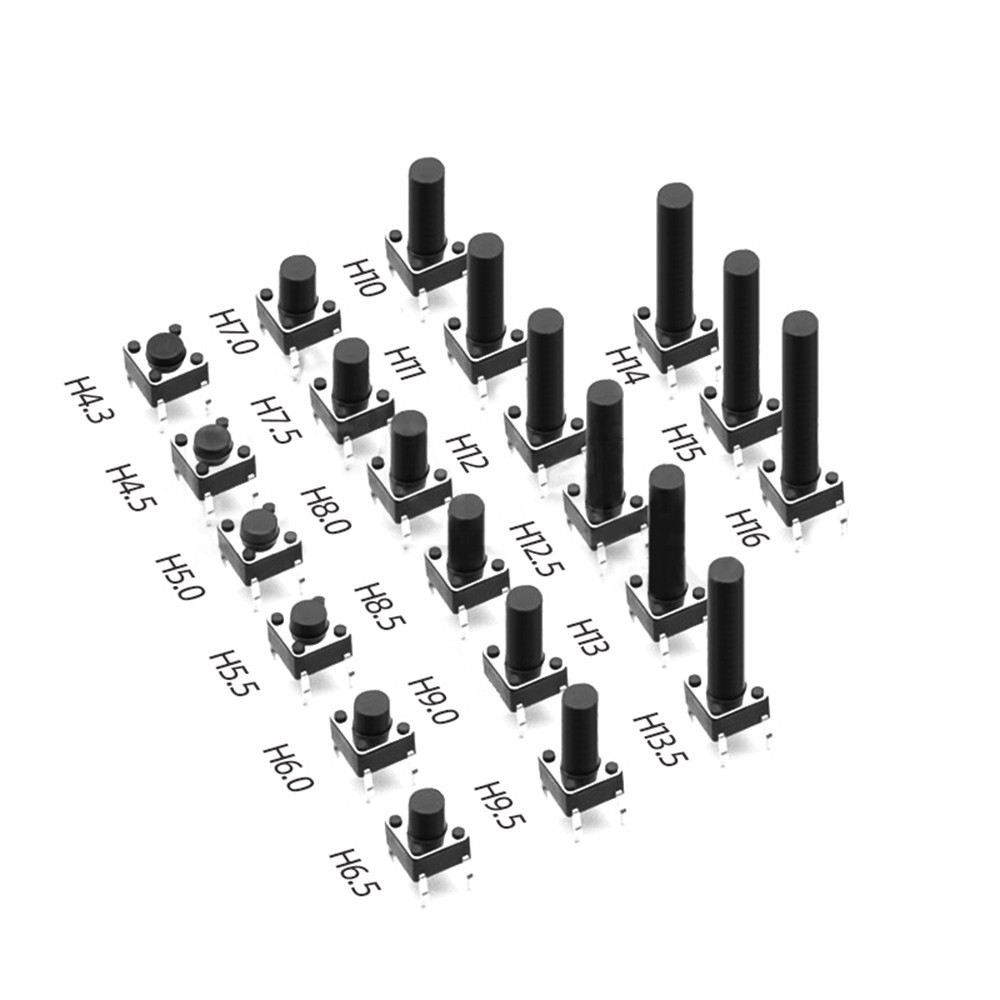
The 6x6 tact switch completes circuit closure by pressing the button and automatically resets upon release. Its core component is a metal spring leaf that deforms under pressure to short-circuit the contacts (closing the circuit), then returns to its original shape upon release (breaking the circuit). This instantaneous action makes it suitable for low-power, momentary-action applications such as power control or data input scenarios.

In rotary knob timer PCBA assemblies, tactile switches typically serve as core control components, handling functions such as mode switching, start/stop timing, and reset/clear operations. Their application design must integrate waterproofing requirements, operational feedback, circuit stability, and longevity specifications.
1. Mode Switching Rotary timers often require switching between multiple timing modes (e.g., forward count, countdown, split timing). Light touch switches trigger the MCU (microcontroller unit) to switch modes via short presses, long presses, or combination presses (e.g., double-tap, triple-tap). The deformation of internal metal springs generates electrical signals, which the MCU recognizes and executes corresponding programs. For example: Short press: Switch to the next mode; Long press for 2 seconds: Enters the settings interface. 2. Start/Stop Timing The “momentary action” characteristic of tactile switches (conductive when pressed, open when released) makes them suitable for controlling timer start/stop functions. When pressed, the electrical signal generated by the switch triggers the MCU to start or stop the timing program; when released, the circuit opens, preventing accidental operation. Some designs employ latching microswitches (press to maintain connection, press again to disconnect), but these require additional circuitry and higher costs, making them a non-mainstream solution. 3. Reset and Clear To rapidly reset timing data during operation, a long press (e.g., 3 seconds) of the microswitch triggers the MCU to execute a reset operation, clearing the count value to zero and restoring the initial state. This function requires implementing debounce logic in the software (e.g., a 10ms delay detection) to prevent accidental resets caused by key bounce.