




A Joystick Potentiometer is an electronic control component that converts mechanical movement into variable electrical signals.It is commonly used in joystick controllers to detect position changes and provide accurate control commands for different devices.
Unlike simple SWITCHes that only provide ON/OFF signals,a Joystick Potentiometer can measure continuous movement in different directions.By changing resistance values according to the joystick position,it allows electronic systems to identify movement angle,direction,and speed.
Due to its precise control capability,compact structure,and reliable performance,Joystick Potentiometers are widely used in gaming controllers,industrial machinery,robotics,medical equipment,and automation systems.
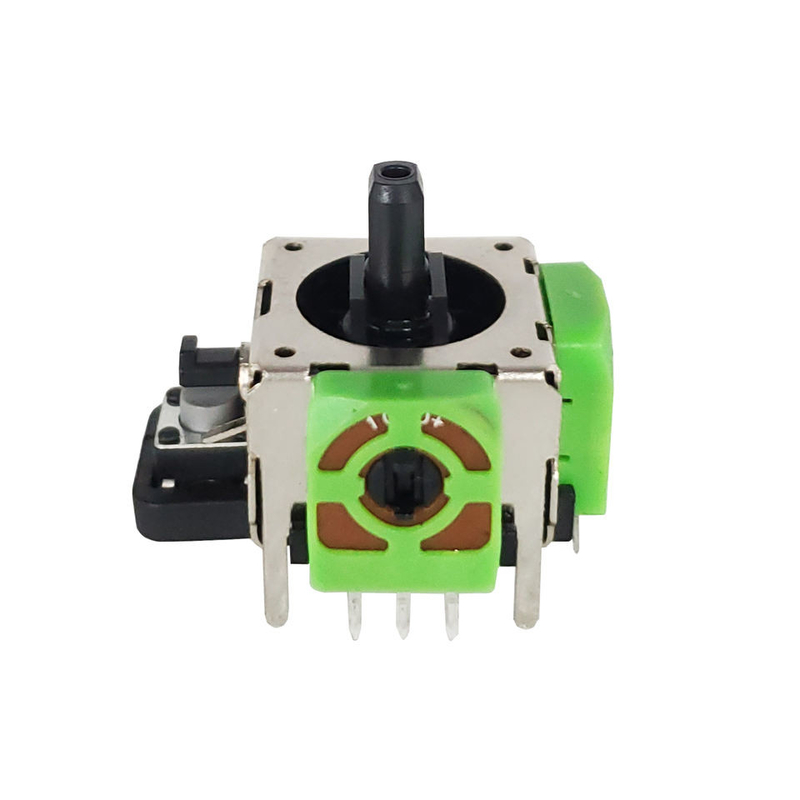
What Is a Joystick Potentiometer?
A Joystick Potentiometer is a type of variable resistor designed specifically for joystick control applications.It usually consists of one or two potentiometers installed on a joystick mechanism to detect movement along different axes.
A typical joystick potentiometer includes:
Joystick handle
Mechanical shaft
Resistive track
Wiper contact
Terminals
Housing structure
When the joystick moves,the internal wiper changes position along the resistive track.This movement changes the resistance value,which is converted into an electrical output signal that controls the connected device.
For example,when a player moves a joystick in a game controller,the joystick potentiometer detects the direction and sends corresponding signals to the control system.
How Does a Joystick Potentiometer Work?
The working principle of a joystick potentiometer is based on variable resistance technology.
The operation process includes three main steps:
1.Mechanical Movement
The user moves the joystick handle in a specific direction,such as left,right,forward,or backward.
2.Resistance Change
The movement drives the internal wiper across the resistive element,changing the resistance ratio.
3.Electrical Signal Output
The changed resistance generates a variable voltage signal,allowing the controller to determine the joystick position.
For a two-axis joystick potentiometer,two independent potentiometers are usually used:
X-axis potentiometer detects horizontal movement
Y-axis potentiometer detects vertical movement
This allows precise two-dimensional motion control.
Key Features of Joystick Potentiometers
1.Accurate Position Detection
Joystick potentiometers provide continuous position feedback,allowing smooth and precise control compared with traditional switches.
2.Compact Mechanical Design
Their small size makes them suitable for devices where installation space is limited,such as controllers,panels,and portable equipment.
3.Easy Integration
Joystick potentiometers can be easily connected with electronic control systems,microcontrollers,and automation equipment.
4.Cost-Effective Solution
Compared with some advanced sensing technologies,potentiometer-based joysticks offer reliable performance at a competitive cost.
5.Customizable Options
Professional potentiometer manufacturers can provide customized solutions,including:
Resistance values
Shaft dimensions
Mounting structures
Axis configurations
Terminal designs
Common Applications of Joystick Potentiometers
1.Gaming Controllers
Gaming devices are one of the most common applications of joystick potentiometers.
They are used in:
Game controllers
Arcade machines
Simulation equipment
Remote gaming devices
The potentiometer detects joystick movement and converts it into game commands.
2.Industrial Control Equipment
In industrial environments,joystick potentiometers provide intuitive machine control.
Applications include:
CNC machines
Industrial robots
Control panels
Automation equipment
Crane and lifting systems
Operators can easily control movement speed and direction through joystick input.
3.Robotics Systems
Robotics applications require accurate motion control.Joystick potentiometers allow operators to control robotic arms,mobile robots,and automated systems.
Their smooth signal output helps achieve precise positioning and movement.
4.Medical Equipment
Joystick potentiometers are also used in medical and rehabilitation equipment,such as:
Electric wheelchairs
Patient lifting systems
Medical control devices
They provide easy and reliable operation for users.
Joystick Potentiometer vs Hall Effect Joystick
Both technologies are widely used in joystick controls,but they work differently.
| Feature | Joystick Potentiometer | Hall Effect Joystick |
|---|---|---|
| Working Principle | Variable resistance | Magnetic field sensing |
| Cost | Lower | Higher |
| Signal Type | Analog voltage output | Magnetic sensing output |
| Durability | Good | Usually longer lifespan |
| Application | Consumer and industrial controls | High-performance applications |
A joystick potentiometer is a practical choice for applications requiring reliable control at a reasonable cost,while Hall effect joysticks are preferred for applications requiring maximum durability.
How to Choose the Right Joystick Potentiometer?
When selecting a joystick potentiometer,several factors should be considered:
1.Axis Configuration
Choose according to control requirements:
Single-axis joystick potentiometer
Two-axis joystick potentiometer
Multi-axis joystick controller
2.Resistance Value
The resistance value should match the electronic circuit requirements.Common values include 1KΩ,5KΩ,and 10KΩ.
3.Operating Life
For industrial applications,select products with high mechanical durability and long operating cycles.
4.Mounting Type
Consider:
Panel mounting
PCB mounting
Custom mounting solutions
5.Environmental Conditions
For harsh environments,choose models with suitable resistance to:
Dust
Vibration
Temperature changes
Moisture
A Joystick Potentiometer is an important motion control component that converts physical joystick movement into precise electrical signals.With advantages such as accurate control,compact design,and cost efficiency,it remains widely used across gaming,industrial automation,robotics,and medical equipment.
For companies searching for reliable control solutions,selecting an experienced joystick potentiometer manufacturer can help ensure product quality,customization capability,and stable supply for different applications.
FAQ
1.What is a joystick potentiometer used for?
A joystick potentiometer is used to detect joystick movement and convert it into electrical signals.It is commonly used in gaming controllers,industrial machines,robotics,medical devices,and automation systems.
2.How many axes does a joystick potentiometer have?
Most joystick potentiometers have one or two axes.A two-axis joystick potentiometer can detect both horizontal(X-axis)and vertical(Y-axis)movement.
3.What is the difference between a joystick potentiometer and a joystick sensor?
A joystick potentiometer detects movement through resistance changes,while a joystick sensor is a broader term that includes other technologies such as Hall effect sensors and optical sensors.
4.Are joystick potentiometers suitable for industrial applications?
Yes.Industrial joystick potentiometers are widely used in machinery control,robotics,and automation systems because they provide reliable analog signal output and precise movement control.
5.Can joystick potentiometers be customized?
Yes.Many custom potentiometer manufacturers provide OEM customization services,including resistance values,mechanical dimensions,mounting methods,and electrical specifications